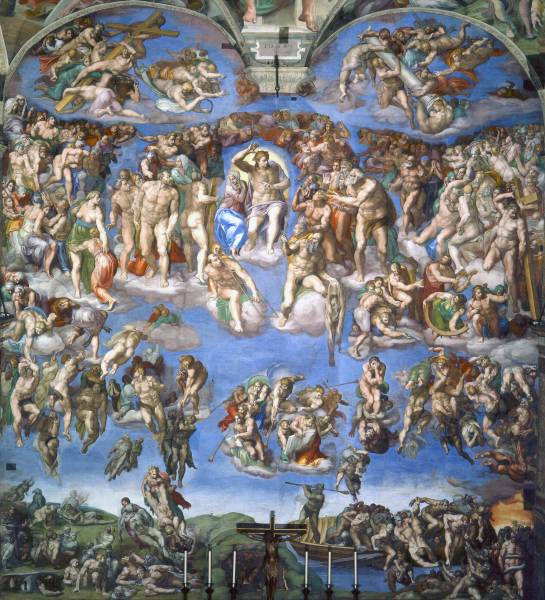
The Last Judgment
(1536)
Michelangelo
(Florence, Italy, 1475 - 1564)
Matthew 25:31-46
In his shorter commentary on Romans 8, Karl Barth describes a state of existence in which humanity has been ‘judged and put to death on the cross’, and yet in which the fear of death has been removed because it ‘has already taken place’ in Christ and ‘we no longer have to endure it.’ This is life under the ‘shadow’ of the cross, but that shadow is ‘the herald of the glory that awaits’ us (Barth 1959:97).
Vittore Carpaccio’s Meditation on the Passion might give us some sense of this mixture of fatal condemnation, and ultimate hope. Death is certainly prominent: the figure of the dead Christ sits slumped on a ruinous marble throne, in the dusty, bone-strewn, foreground. The crown of thorns and the sharp, lance-like shadows on the ground, are reminders of the Passion. Combining aspects of the Man of Sorrows, Christ on the Cold Stone, and Christ Enthroned, he is accompanied, not by supporting angels, a mourning Virgin, or lamenting disciples, but by Job (on the right) and St Jerome with his companion lion (on the left).
The beleaguered prophet, and the fourth century ascetic saint—translator of the Bible, and author of a commentary on Job—provide a counterweight to what Barth called the ‘inexorable fatality’ of the shadow of the cross (1959: 97). The crumbling marble block on which Job sits is inscribed with some of his most celebrated words: ‘my Redeemer lives’ (Job 19:25–27). Job, the great sufferer, proffers the hope of the resurrection and points towards the viewers as if to indicate that Christ’s death is for them, while Jerome’s outward gaze reinforces this connection. The shadow of death is not permanent, and Job and Jerome testify to the coming glory.
Found in: Romans, Romans 8, 15th century
18 For I consider that the sufferings of this present time are not worthy to be compared with the glory which will be revealed toward us.
19 For the creation waits with eager expectation for the children of God to be revealed.
20 For the creation was subjected to vanity, not of its own will, but because of him who subjected it, in hope
21 that the creation itself also will be delivered from the bondage of decay into the liberty of the glory of the children of God.
22 For we know that the whole creation groans and travails in pain together until now.
23 Not only so, but ourselves also, who have the first fruits of the Spirit, even we ourselves groan within ourselves, waiting for adoption, the redemption of our body.
24 For we were saved in hope, but hope that is seen is not hope. For who hopes for that which he sees?
25 But if we hope for that which we don’t see, we wait for it with patience.
26 In the same way, the Spirit also helps our weaknesses, for we don’t know how to pray as we ought. But the Spirit himself makes intercession for us with groanings which can’t be uttered.
27 He who searches the hearts knows what is on the Spirit’s mind, because he makes intercession for the saints according to God.
28 We know that all things work together for good for those who love God, to those who are called according to his purpose.
29 For whom he foreknew, he also predestined to be conformed to the image of his Son, that he might be the firstborn among many brothers.
30 Whom he predestined, those he also called. Whom he called, those he also justified. Whom he justified, those he also glorified.
31 What then shall we say about these things? If God is for us, who can be against us?
32 He who didn’t spare his own Son, but delivered him up for us all, how would he not also with him freely give us all things?
33 Who could bring a charge against God’s chosen ones? It is God who justifies.
34 Who is he who condemns? It is Christ who died, yes rather, who was raised from the dead, who is at the right hand of God, who also makes intercession for us.
35 Who shall separate us from the love of Christ? Could oppression, or anguish, or persecution, or famine, or nakedness, or peril, or sword?
36 Even as it is written, “For your sake we are killed all day long. We were accounted as sheep for the slaughter.”
37 No, in all these things, we are more than conquerors through him who loved us.
38 For I am persuaded that neither death, nor life, nor angels, nor principalities, nor things present, nor things to come, nor powers,
39 nor height, nor depth, nor any other created thing, will be able to separate us from God’s love, which is in Christ Jesus our Lord.
Romans 8:18-39 · World English Bible

1465 - 1525
Venice, Italy
Vittore Carpaccio was an Italian painter of the Venetian school, who studied under Gentile Bellini. He is best known for a cycle of nine paintings, The Legend of Saint Ursula. His style was somewhat conservative, showing little influence from the Humanist trends that transformed Italian Renaissance painting during his lifetime. He was influenced by the style of Antonello da Messina and Early Netherlandish art. For this reason, and also because so much of his best work remains in Venice, his…