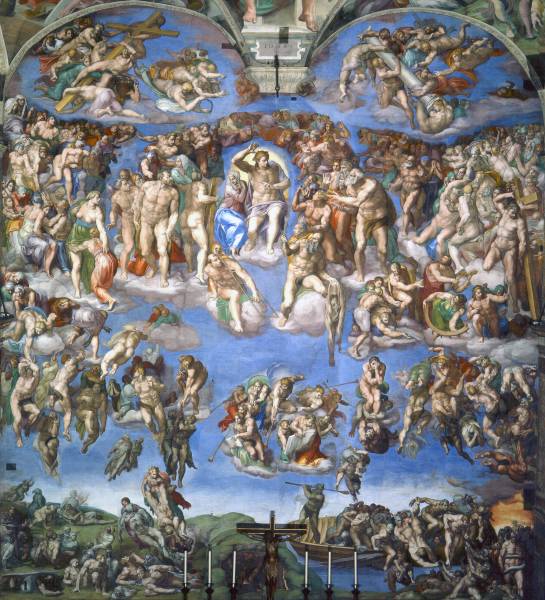
The Last Judgment
(1536)
Michelangelo
(Florence, Italy, 1475 - 1564)
Matthew 25:31-46
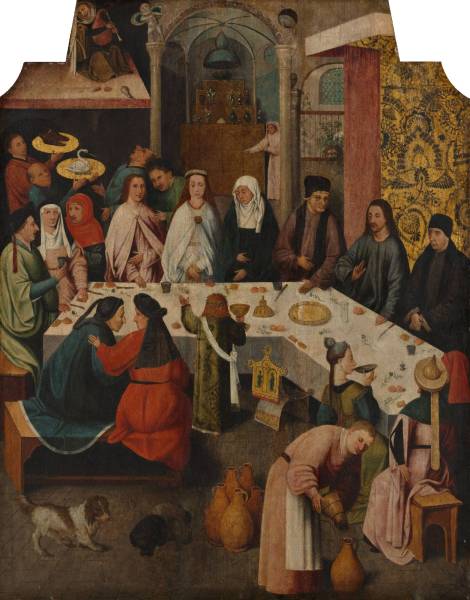
Peter Paul Rubens' "The Feast in the House of Simon the Pharisee" brings to life a poignant scene from the New Testament, as described in Luke 7:36-50. The painting captures the moment when Jesus visits the home of Simon the Pharisee, only to be met with a profound display of devotion and humility by a "sinful woman" who anoints his feet with perfume. This dramatic and intimate scene is woven together with Rubens' characteristic mastery, inviting the viewer to contemplate the emotional and spiritual depths of the encounter.
The artistic composition of "The Feast in the House of Simon the Pharisee" is a testament to Rubens' skill in balancing light, color, and movement. The scene is set against a backdrop of warm, golden hues, with the figures of Jesus, Simon, and the other guests arranged in a dynamic, serpentine curve. The woman at Jesus' feet is the emotional center of the painting, her face upturned in a gesture of ardent devotion as she pours the perfume onto his feet. The overall effect is one of captivating drama and emotional intensity, drawing the viewer into the heart of the scene.
The painting is also rich in symbolism, with the "sinful woman" representing the redemptive power of faith and humility. The anointing of Jesus' feet is often seen as a prefiguration of his burial, and the woman's act is a powerful expression of her love and gratitude for his teachings. Meanwhile, the figure of Simon the Pharisee serves as a counterpoint, embodying the skepticism and doubt that often greeted Jesus' message. Through these contrasting figures, Rubens offers a nuanced exploration of the human response to Jesus' teachings, inviting the viewer to reflect on their own spiritual journey.
As a work of art, "The Feast in the House of Simon the Pharisee" is significant not only for its technical mastery, but also for its profound engagement with the biblical narrative. Painted between 1618 and 1620, the work represents a high point in Rubens' oeuvre, showcasing his ability to balance dramatic intensity with spiritual subtlety. Today, the painting remains a powerful and moving testament to the enduring power of faith and devotion, offering a compelling window into the artistic and spiritual sensibilities of the Baroque era.
Found in: Luke, Luke 7, 17th century
36 One of the Pharisees invited him to eat with him. He entered into the Pharisee’s house, and sat at the table.
37 Behold, a woman in the city who was a sinner, when she knew that he was reclining in the Pharisee’s house, brought an alabaster jar of ointment.
38 Standing behind at his feet weeping, she began to wet his feet with her tears, and she wiped them with the hair of her head, kissed his feet, and anointed them with the ointment.
39 Now when the Pharisee who had invited him saw it, he said to himself, “This man, if he were a prophet, would have perceived who and what kind of woman this is who touches him, that she is a sinner.”
40 Jesus answered him, “Simon, I have something to tell you.” He said, “Teacher, say on.”
41 “A certain lender had two debtors. The one owed five hundred denarii, and the other fifty.
42 When they couldn’t pay, he forgave them both. Which of them therefore will love him most?”
43 Simon answered, “He, I suppose, to whom he forgave the most.” He said to him, “You have judged correctly.”
44 Turning to the woman, he said to Simon, “Do you see this woman? I entered into your house, and you gave me no water for my feet, but she has wet my feet with her tears, and wiped them with the hair of her head.
45 You gave me no kiss, but she, since the time I came in, has not ceased to kiss my feet.
46 You didn’t anoint my head with oil, but she has anointed my feet with ointment.
47 Therefore I tell you, her sins, which are many, are forgiven, for she loved much. But to whom little is forgiven, the same loves little.”
48 He said to her, “Your sins are forgiven.”
49 Those who sat at the table with him began to say to themselves, “Who is this who even forgives sins?”
50 He said to the woman, “Your faith has saved you. Go in peace.”
Luke 7:36-50 · World English Bible