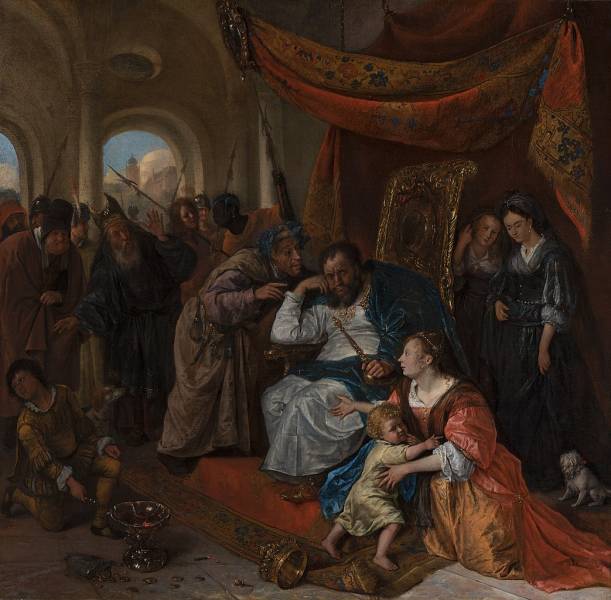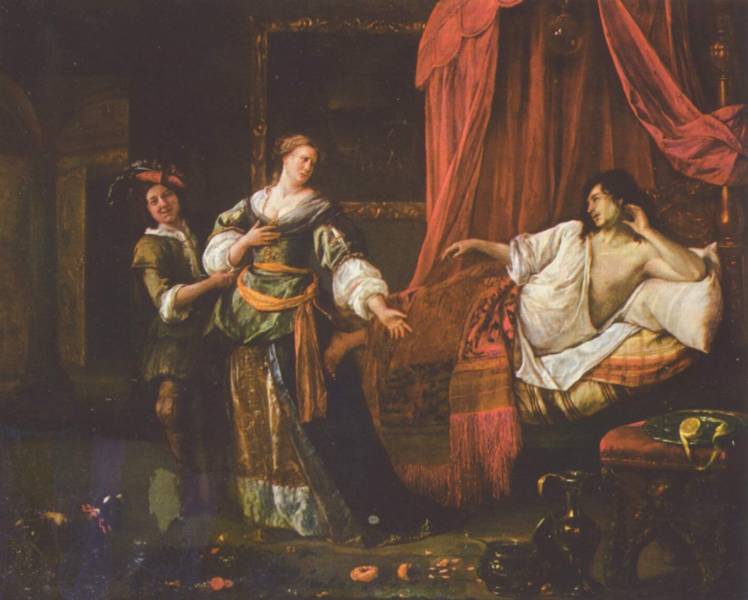
Amnon and Tamar
(1665)
Jan Steen
(Leiden, 1626 - 1679)
2 Samuel 13:1-22
More than 300 years after his death, Jan Steen (1626-1679) is still identified primarily as a genre painter of Dutch middle- and lower-class life. In sharp contrast to the calm, ordered interiors of his contemporaries, Pieter de Hooch, for example, or Jan Vermeer, Steen's pictures show the tidy Dutch life gone awry: messy kitchens, drunken scullery maids, lazy housewives, unruly children, even the bedlam of tavern interiors. Indeed, when the Dutch wished to describe a disordered household, they used the phrase "a Jan Steen household."
Moreover, because Steen's father had been a brewer and Steen himself was an innkeeper, biographers assumed the paintings were autobiographical, that Steen himself was often drunk. Matters were not helped when Steen sometimes included his own likeness in the paintings. Whatever the facts may be, the picture Steen's early biographers painted of him is not entirely accurate. Among the 800 or so works he painted (more than half of which remained in his possession, unsold, at his death) were a sizable number of history, religious, and mythological subjects—enough, certainly, to establish, in addition to his reputation for genre, a respectable reputation as a history painter.
Early in his career Steen's history paintings concentrated mainly on stories from the New Testament. Later, he turned to Greek and Roman history and to the Old Testament, with dramatic narratives of figures such as Iphigenia, Scipio, Anthony and Cleopatra, Tobias and Sarah, David and Goliath, Bathsheba, Laban, Moses, Esther, Tamar, and Samson, among them. The Worship of the Golden Calf is one of these.
If it was painted sometime around 1671 or 1672 as is believed, Steen would have been in the midst of major disruptions in his life, including, within a short period, the loss of his wife of 20 years and his father as well as the removal of his household from Haarlem, where he had worked for almost 10 years, to his native Leiden and into his father's house. The country, meanwhile, was being marked by political and economic upheaval. In a surprise attack, Louis XIV (with the tacit support of the English monarch) invaded the Dutch Republic.
Thecountry was saved from the French only when the newly created Willem III of Orange, apparently considering the sea the lesser of two evils, opened the sluice gates and flooded the countryside. It was about this time, probably as a result of the ensuing economic hardship, that Steen opened a tavern in his father's house. It is also probably this action that provided so much grist for his early biographers.
At first glance, The Worship of the Golden Calf looks as confused and disordered as a "Steen household. " Such is not the case, however. The journey through the picture is well marked, allowing the spectator to "read" it quite easily. Using Chapter 32 of Exodus, Steen has set up the narrative loosely in quadrants. The lower half of the work consists of a solid wall of people, more or less contemporary, more or less life size, while the upper half, clearly depicting a far distant time, consists of tiny figures dancing in a circle around a column. (Their serpentine grace brings to mind the dancing figures of Matisse at the Hermitage.) The figures of the golden calf and of Aaron offering incense are clearly visible in the right upper quadrant. Behind them is Mount Sinai, where Moses has been delayed. In the left upper quadrant, the figure of a young boy hangs precariously from a tree branch, Steen's nod, perhaps, to the putti of Renaissance paintings. The left lower quadrant is the men's section.
They are soldiers, drummers, musicians, each intent on wooing one of the women. The right lower quadrant, by contrast, is almost exclusively women, engaged in the activities of women: at the tar right, cooking, toward the center nursing, singing, and, prominently on the right, an old woman offering a coin to a young girl bedecked
with fresh flowers, a symbol of what the Dutch refer to as de flourerien.
All of this is, however, but a prop for the two figures in the center of the foreground. Enclosed in a roughly inverted triangle they are engaged in a transaction whose outcome cannot be doubted. If Steen's viewers needed further confirmation of the intent, he obliged them with the triangle and baton held by the man and the cup of wine and urn held by the woman. And, if doubtful viewers still needed prompting, Steen has painted a still life—worthy of a frame to itself-in the lower right corner. The half eaten loaf of bread, the overturned pitcher, the split melon, the Pipes of Pan, and, at the very bottom edge of the canvas, a gourd (on which Steen signed his name). Steen's likeness is also on the race of the man with the triangle. Like other Dutch painting of the 17th century, Steen's work pointed a moral. Sometimes he spelled out the letters of a Dutch motto on the canvas; sometimes there was no need for words. Here, for example, over at the left margin of the canvas, the moral takes the form of a tiny, curly-headed child with a parrot on his wrist. Nearly lost in the wilderness of figures, it serves as a vanitas symbol, warning the viewer of the insatiability of lust, the brevity of gratification. In addition, the viewer's own background would also make Steen's admonition explicit. For example, in a kind of time warp, lie places the behavior of his own countrymen against the background of a scripture scene that is well known to them. But even for those who do not care about the moral, Steen has a message of beauty. For them he provides a lush, brilliantly colored scene of music and dance, food, flowers, and glitter, truly "an
embarrassment of riches.""
Found in: Exodus, Exodus 32, 17th century, Golden Calf
1 When the people saw that Moses delayed to come down from the mountain, the people gathered themselves together to Aaron, and said to him, “Come, make us gods, which shall go before us; for as for this Moses, the man who brought us up out of the land of Egypt, we don’t know what has become of him.”
2 Aaron said to them, “Take off the golden rings, which are in the ears of your wives, of your sons, and of your daughters, and bring them to me.”
3 All the people took off the golden rings which were in their ears, and brought them to Aaron.
4 He received what they handed him, fashioned it with an engraving tool, and made it a molten calf. Then they said, “These are your gods, Israel, which brought you up out of the land of Egypt.”
5 When Aaron saw this, he built an altar before it; and Aaron made a proclamation, and said, “Tomorrow shall be a feast to Yahweh.”
6 They rose up early on the next day, and offered burnt offerings, and brought peace offerings; and the people sat down to eat and to drink, and rose up to play.
7 Yahweh spoke to Moses, “Go, get down; for your people, who you brought up out of the land of Egypt, have corrupted themselves!
8 They have turned away quickly out of the way which I commanded them. They have made themselves a molten calf, and have worshiped it, and have sacrificed to it, and said, ‘These are your gods, Israel, which brought you up out of the land of Egypt.’”
9 Yahweh said to Moses, “I have seen these people, and behold, they are a stiff-necked people.
10 Now therefore leave me alone, that my wrath may burn hot against them, and that I may consume them; and I will make of you a great nation.”
11 Moses begged Yahweh his God, and said, “Yahweh, why does your wrath burn hot against your people, that you have brought out of the land of Egypt with great power and with a mighty hand?
12 Why should the Egyptians speak, saying, ‘He brought them out for evil, to kill them in the mountains, and to consume them from the surface of the earth?’ Turn from your fierce wrath, and repent of this evil against your people.
13 Remember Abraham, Isaac, and Israel, your servants, to whom you swore by your own self, and said to them, ‘I will multiply your offspring as the stars of the sky, and all this land that I have spoken of I will give to your offspring, and they shall inherit it forever.’”
14 Yahweh repented of the evil which he said he would do to his people.
15 Moses turned, and went down from the mountain, with the two tablets of the testimony in his hand; tablets that were written on both their sides; on the one side and on the other they were written.
16 The tablets were the work of God, and the writing was the writing of God, engraved on the tablets.
17 When Joshua heard the noise of the people as they shouted, he said to Moses, “There is the noise of war in the camp.”
18 He said, “It isn’t the voice of those who shout for victory. It is not the voice of those who cry for being overcome; but the noise of those who sing that I hear.”
19 As soon as he came near to the camp, he saw the calf and the dancing. Then Moses’ anger grew hot, and he threw the tablets out of his hands, and broke them beneath the mountain.
20 He took the calf which they had made, and burned it with fire, ground it to powder, and scattered it on the water, and made the children of Israel drink it.
21 Moses said to Aaron, “What did these people do to you, that you have brought a great sin on them?”
22 Aaron said, “Don’t let the anger of my lord grow hot. You know the people, that they are set on evil.
23 For they said to me, ‘Make us gods, which shall go before us. As for this Moses, the man who brought us up out of the land of Egypt, we don’t know what has become of him.’
24 I said to them, ‘Whoever has any gold, let them take it off:’ so they gave it to me; and I threw it into the fire, and out came this calf.”
25 When Moses saw that the people had broken loose, (for Aaron had let them loose for a derision among their enemies),
26 then Moses stood in the gate of the camp, and said, “Whoever is on Yahweh’s side, come to me!” All the sons of Levi gathered themselves together to him.
27 He said to them, “Yahweh says, the God of Israel, ‘Every man put his sword on his thigh, and go back and forth from gate to gate throughout the camp, and every man kill his brother, and every man his companion, and every man his neighbor.’”
28 The sons of Levi did according to the word of Moses: and there fell of the people that day about three thousand men.
29 Moses said, “Consecrate yourselves today to Yahweh, yes, every man against his son, and against his brother; that he may give you a blessing today.”
30 On the next day, Moses said to the people, “You have sinned a great sin. Now I will go up to Yahweh. Perhaps I shall make atonement for your sin.”
31 Moses returned to Yahweh, and said, “Oh, this people have sinned a great sin, and have made themselves gods of gold.
32 Yet now, if you will, forgive their sin—and if not, please blot me out of your book which you have written.”
33 Yahweh said to Moses, “Whoever has sinned against me, him will I blot out of my book.
34 Now go, lead the people to the place of which I have spoken to you. Behold, my angel shall go before you. Nevertheless in the day when I punish, I will punish them for their sin.”
35 Yahweh struck the people, because they made the calf, which Aaron made.
Exodus 32 · World English Bible
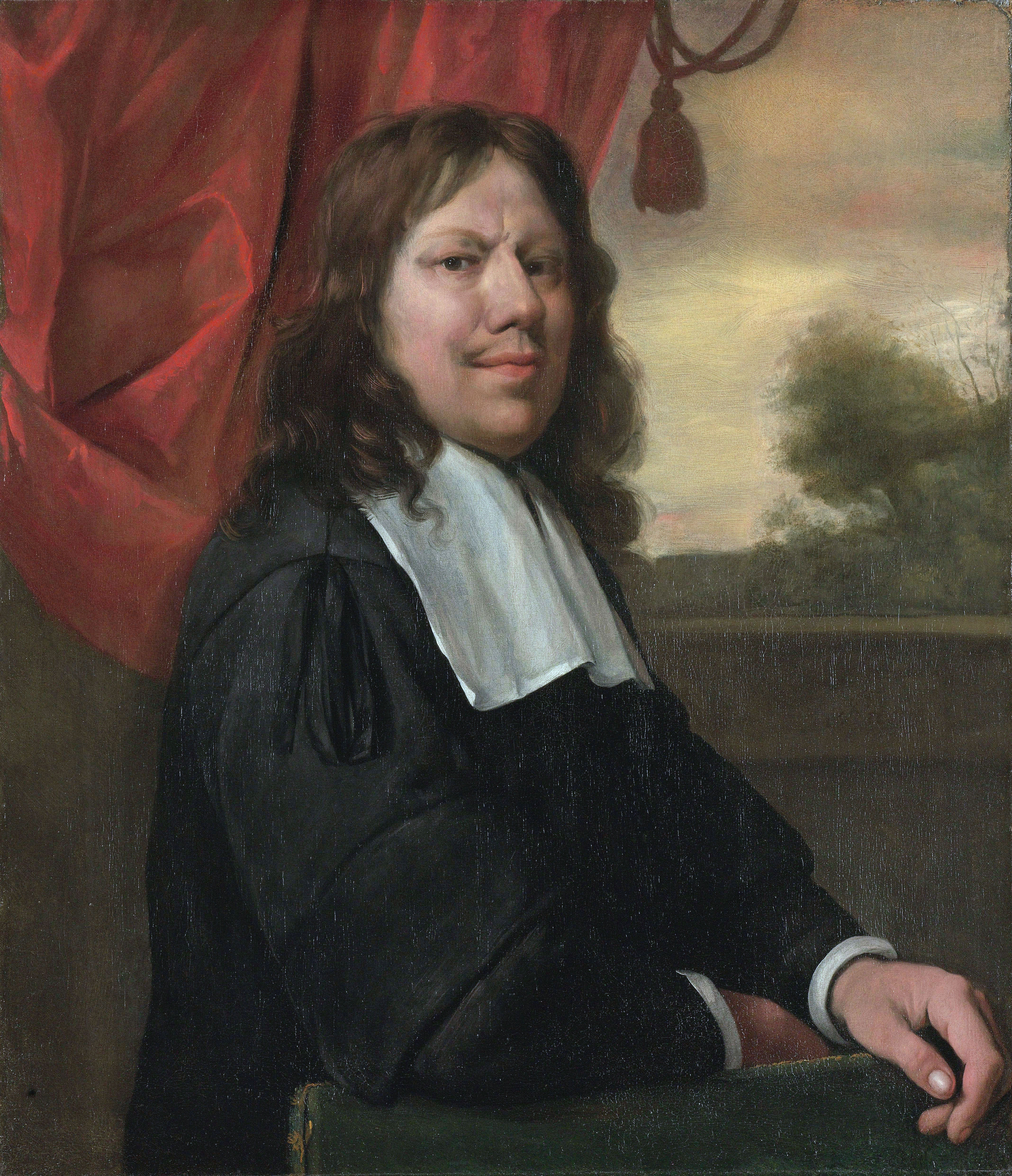
1626 - 1679
Leiden, Netherland
Jan Havickszoon Steen (c. 1626 – buried 3 February 1679) was a Dutch genre painter of the 17th century (also known as the Dutch Golden Age). His works are known for their psychological insight, sense of humour and abundance of colour.