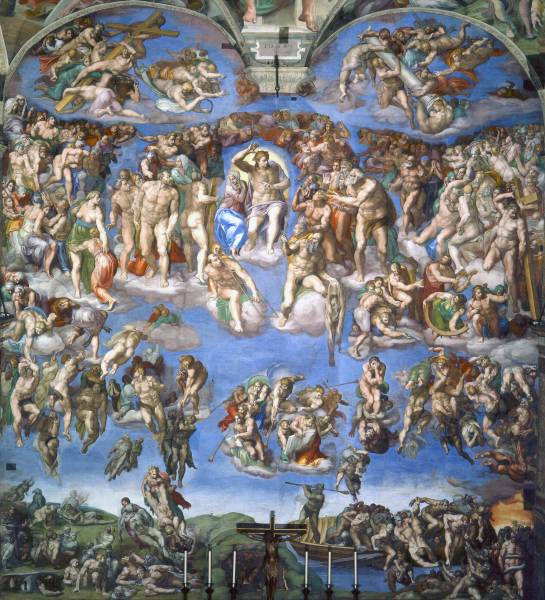
The Last Judgment
(1536)
Michelangelo
(Florence, Italy, 1475 - 1564)
Matthew 25:31-46
As contrasting pairs [see the second image in the "details"] the Fall and the Redemption of Man, death and life, a paradise flooded with light and a dark overcast horizon, find their formal counterpart in this stylistic and compositional realisation of the theme. The delicate and sharply contoured bodies of the first two human beings are quite different from the figures in the Lamentation, which are interpreted in a painterly fashion and set restlessly into the scene in a continuation of the tradition of Rogier van der Weyden’s expressive painting. This has led to the supposition that the two panels were painted at different points in time, rather far apart from one another. Goes, in his striking rendition of the “tempter” with the head of a woman, body of a salamander and feet of an aquatic bird, was falling back on an existing tradition that was occasionally found in Netherlandish (book) paintings. The work is mentioned in 1659 in the inventory of the collection of Archduke Leopold Wilhelm but attributed in error to Jan van Eyck. Later all knowledge was lost that the two panels of the diptych, which had meanwhile been separated, belonged together. The former outside panel has also been preserved (KHM, GG, Inv. No. 5822 B). They were not presented together again until 1884 and 1887, by that time attributed to van der Goes. Initially, Hugo van der Goes worked primarily in Ghent. His involvement in the decorations for the wedding of Charles the Bold of Burgundy to Margaret of York in Bruges in 1468, however, brought him more widespread fame, awakening the interest of the archduke and later emperor Maximilian. The latter visited the painter in 1477 during a stay in Ghent and Brussels on the occasion of his marriage to Mary of Burgundy. By then, Goes, who was already suffering from depression, had entered the quiet seclusion of a monastery.
Found in: Genesis, Genesis 3, 15th century, The Fall of Man, Vienna Diptych
1 Now the serpent was more subtle than any animal of the field which Yahweh God had made. He said to the woman, “Has God really said, ‘You shall not eat of any tree of the garden?’”
2 The woman said to the serpent, “We may eat fruit from the trees of the garden,
3 but not the fruit of the tree which is in the middle of the garden. God has said, ‘You shall not eat of it. You shall not touch it, lest you die.’”
4 The serpent said to the woman, “You won’t really die,
5 for God knows that in the day you eat it, your eyes will be opened, and you will be like God, knowing good and evil.”
6 When the woman saw that the tree was good for food, and that it was a delight to the eyes, and that the tree was to be desired to make one wise, she took some of its fruit, and ate; and she gave some to her husband with her, and he ate it, too.
7 Their eyes were opened, and they both knew that they were naked. They sewed fig leaves together, and made coverings for themselves.
8 They heard Yahweh God’s voice walking in the garden in the cool of the day, and the man and his wife hid themselves from the presence of Yahweh God among the trees of the garden.
9 Yahweh God called to the man, and said to him, “Where are you?”
10 The man said, “I heard your voice in the garden, and I was afraid, because I was naked; and I hid myself.”
11 God said, “Who told you that you were naked? Have you eaten from the tree that I commanded you not to eat from?”
12 The man said, “The woman whom you gave to be with me, she gave me fruit from the tree, and I ate it.”
13 Yahweh God said to the woman, “What have you done?” The woman said, “The serpent deceived me, and I ate.”
Genesis 3:1-13 · World English Bible

1430 - 1482
Ghent, Belgium
Hugo van der Goes (probably Ghent c. 1430/1440 – Auderghem 1482) was one of the most significant and original Flemish painters of the late 15th century. Van der Goes was an important painter of altarpieces as well as portraits. He introduced important innovations in painting through his monumental style, use of a specific colour range and individualistic manner of portraiture. The presence of his masterpiece, the Portinari Triptych in Florence, from 1483 onwards played a role in the development of…