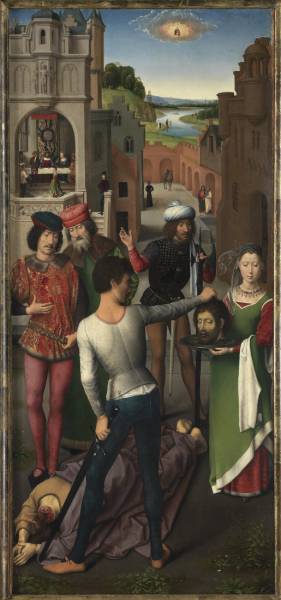
Hans Memling
(Seligenstadt, 1430 - 1494)
Mark 6:14-29
The composition of this little work is clearly a reprise of the central panel of the Bladelin triptych (Berlin, Staatliche Museen) by Van der Weyden. It has, however, been simplified and the proportions of the figures with respect to the architecture made more natural. The angels have been omitted and the stable transformed into a realistic architectural fragment, according to Memling's custom, with a spatial function that transcends the field of view of the painting. All the typological and iconographical ingredients of the earlier example are otherwise present. We know that this presentation of Mary, dressed in white and suddenly and painlessly praying to her new-born Child, derives from the 'Revelationes' of St Bridget of Sweden (fourteenth century). The way Joseph, holding his candle, is overwhelmed by the divine light also derives from that source, as does the pillar on the left which Mary saw during the birth and which symbolises Christ's flagellation. Memling also retains in his composition the cellar entrance at the front, which might be an allusion to the cave in Bethlehem where Christ was born.
It is generally accepted that the painting should be ascribed to Memling and dated to around 1470. The figures do indeed retain the rather stocky frame and rounded physiognomy of the earliest works. Mary is identical to the Ottawa Virgin, which dates from 1472. The little painting also closely resembles the Nativity in the left wing of the Prado triptych in terms of style. A date of around 1470-72 would thus appear likely.
The painting, in all probability, have been the central panel of a small triptych with donor wings on either side, or possibly an iconography that was also inspired by the Bladelin triptych. It must have been located in or around Bruges, because it was copied towards the end of the fifteenth century in a small tondo located in St John's Hospital in Damme.
The painting is in its original frame.
Found in: Luke, Luke 2, 15th century, The Birth of Jesus
1 Now in those days, a decree went out from Caesar Augustus that all the world should be enrolled.
2 This was the first enrollment made when Quirinius was governor of Syria.
3 All went to enroll themselves, everyone to his own city.
4 Joseph also went up from Galilee, out of the city of Nazareth, into Judea, to David’s city, which is called Bethlehem, because he was of the house and family of David;
5 to enroll himself with Mary, who was pledged to be married to him as wife, being pregnant.
6 While they were there, the day had come for her to give birth.
7 She gave birth to her firstborn son. She wrapped him in bands of cloth, and laid him in a feeding trough, because there was no room for them in the inn.
8 There were shepherds in the same country staying in the field, and keeping watch by night over their flock.
9 Behold, an angel of the Lord stood by them, and the glory of the Lord shone around them, and they were terrified.
10 The angel said to them, “Don’t be afraid, for behold, I bring you good news of great joy which will be to all the people.
11 For there is born to you today, in David’s city, a Savior, who is Christ the Lord.
12 This is the sign to you: you will find a baby wrapped in strips of cloth, lying in a feeding trough.”
13 Suddenly, there was with the angel a multitude of the heavenly army praising God, and saying,
14 “Glory to God in the highest, on earth peace, good will toward men.”
15 When the angels went away from them into the sky, the shepherds said to one another, “Let’s go to Bethlehem, now, and see this thing that has happened, which the Lord has made known to us.”
16 They came with haste, and found both Mary and Joseph, and the baby was lying in the feeding trough.
17 When they saw it, they publicized widely the saying which was spoken to them about this child.
18 All who heard it wondered at the things which were spoken to them by the shepherds.
19 But Mary kept all these sayings, pondering them in her heart.
20 The shepherds returned, glorifying and praising God for all the things that they had heard and seen, just as it was told them.
21 When eight days were fulfilled for the circumcision of the child, his name was called Jesus, which was given by the angel before he was conceived in the womb.
Luke 2:1-21 · World English Bible

1430 - 1494
Seligenstadt, Germany
Hans Memling (also spelled Memlinc; c. 1430 – 11 August 1494) was a German painter who moved to Flanders and worked in the tradition of Early Netherlandish painting. He was born in the Middle Rhine region, and probably spent his childhood in Mainz. He had moved to the Netherlands by 1465 and spent time in the Brussels workshop of Rogier van der Weyden. He was subsequently made a citizen of Bruges, where he became one of the leading artists, painting…