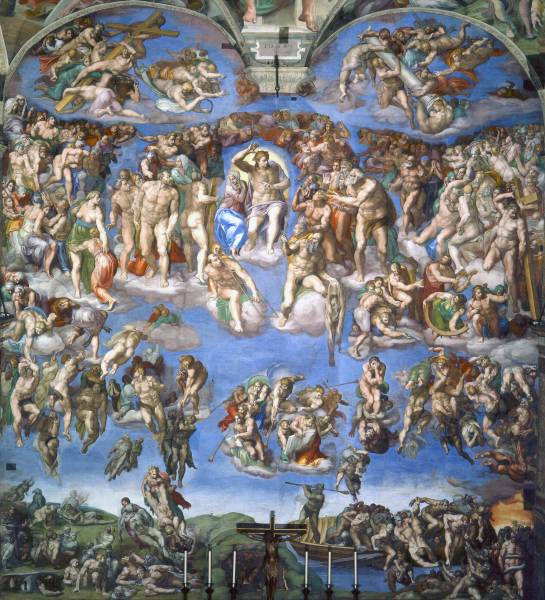
The Last Judgment
(1536)
Michelangelo
(Florence, Italy, 1475 - 1564)
Matthew 25:31-46
This painting depicts a story from the Bible’s Old Testament. In the white dress on the chair is Esther, wife of the Persian King Ahasuerus, who (it’s written) concealed from her husband that she was Jewish. The king’s chief minister, Haman, hated Esther’s adoptive father, Mordecai, so in a subtle plot to kill him, he convinced the king to issue a decree of execution against Jews.
On hearing of the decree, Esther held a banquet where she revealed her Jewish identity and pleaded for her people. The King briefly left the banquet and returned to find this chief minister kneeling before the queen. Believing that Haman was attempting to seduce Esther, Ahasuerus had him executed. After this, the Jews established an annual festival on the 14th day of the month of Adar (February/March) known as 'Purim' or 'The Festival of Esther'.
In his painting Edward Armitage shows Haman (in the foreground with the yellow headdress) begging Esther for forgiveness, about to be smothered by guards and taken to his death. Mordecai stands behind the table looking down upon the treacherous Haman, while the queen's pale skin and white costume give her regal status and innocence. Although the scene is a dramatic one, the tension is measured; understated details such as Haman's overturned goblet and the carpet's flipped up corner are used to signal unrest.
Found in: Esther, Esther 7, 19th century
1 So the king and Haman came to banquet with Esther the queen.
2 The king said again to Esther on the second day at the banquet of wine, “What is your petition, queen Esther? It shall be granted you. What is your request? Even to the half of the kingdom it shall be performed.”
3 Then Esther the queen answered, “If I have found favor in your sight, O king, and if it pleases the king, let my life be given me at my petition, and my people at my request.
4 For we are sold, I and my people, to be destroyed, to be slain, and to perish. But if we had been sold for male and female slaves, I would have held my peace, although the adversary could not have compensated for the king’s loss.”
5 Then King Ahasuerus said to Esther the queen, “Who is he, and where is he who dared presume in his heart to do so?”
6 Esther said, “An adversary and an enemy, even this wicked Haman!” Then Haman was afraid before the king and the queen.
7 The king arose in his wrath from the banquet of wine and went into the palace garden. Haman stood up to make request for his life to Esther the queen; for he saw that there was evil determined against him by the king.
8 Then the king returned out of the palace garden into the place of the banquet of wine; and Haman had fallen on the couch where Esther was. Then the king said, “Will he even assault the queen in front of me in the house?” As the word went out of the king’s mouth, they covered Haman’s face.
Esther 7:1-8 · World English Bible

1817 - 1896
England, London
Armitage was born in London to a family of wealthy Yorkshire industrialists, the eldest of seven sons of James Armitage (1793–1872) and Anne Elizabeth Armitage née Rhodes (1788–1833), of Farnley Hall, just south of Leeds, Yorkshire. His great-grandfather James (1730–1803) bought Farnley Hall from Sir Thomas Danby in 1799 and in 1844 four Armitage brothers, including his father James, founded the Farnley Ironworks, utilising the coal, iron and fireclay on their estate. His brother Thomas Rhodes Armitage (1824–1890) founded the…