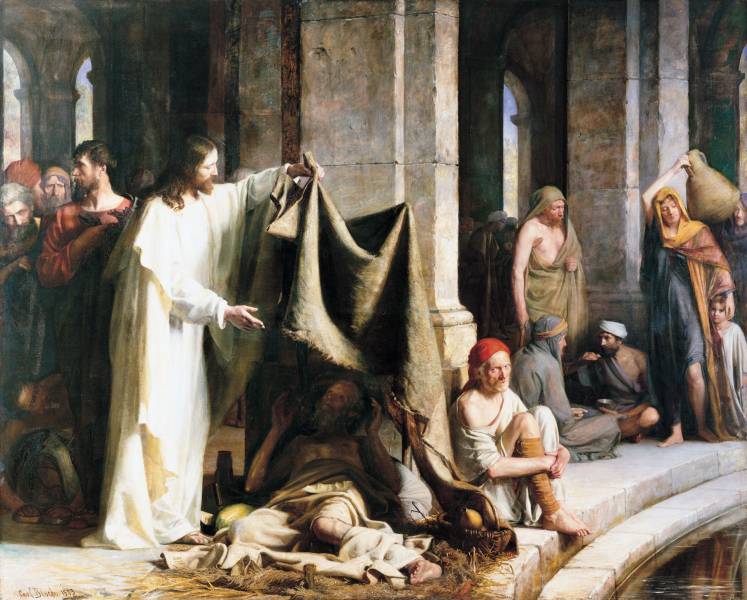
Carl Bloch
(Copenhagen, 1834 - 1890)
John 5:2-9
Carl Heinrich Bloch's "The Denial of Peter" is a painting that depicts the moment in the Gospel of Luke when Peter denies knowing Jesus three times, just as the Lord had prophesied. The painting captures Peter's emotional turmoil, as he grapples with the weight of his actions and the guilt that accompanies his denial.
Bloch's painting is set in a dimly lit room, with a fire burning in the hearth. Peter is seated at a table, surrounded by soldiers and servants. He is clearly agitated, his face flushed and his hands clasped together tightly. His eyes dart around the room, as if he is looking for a way to escape.
In the foreground of the painting, a woman approaches Peter and asks if he is one of Jesus' disciples. Peter denies it, saying, "I do not know him." The woman then turns to the other people in the room and repeats her question. Peter denies it again, and then a third time.
Bloch's painting captures the emotional intensity of this moment. Peter's face is a mask of fear and guilt. He knows that he has denied Jesus, and he is ashamed of himself. The firelight flickers in his eyes, reflecting the inner turmoil that he is feeling.
The denial of Peter is a significant moment in the Christian story. It is a reminder that even the most faithful of followers can fall short. But it is also a story of redemption. After Jesus is resurrected, he appears to Peter and asks him if he loves him. Peter answers three times, "Yes, Lord." And Jesus forgives him.
Bloch's painting is a powerful reminder of the human capacity for both sin and redemption. It is a painting that can be appreciated by people of all faiths.
Here is a more detailed analysis of the painting:
Found in: Luke, Luke 22, 19th century
54 They seized him, and led him away, and brought him into the high priest’s house. But Peter followed from a distance.
55 When they had kindled a fire in the middle of the courtyard, and had sat down together, Peter sat among them.
56 A certain servant girl saw him as he sat in the light, and looking intently at him, said, “This man also was with him.”
57 He denied Jesus, saying, “Woman, I don’t know him.”
58 After a little while someone else saw him, and said, “You also are one of them!” But Peter answered, “Man, I am not!”
59 After about one hour passed, another confidently affirmed, saying, “Truly this man also was with him, for he is a Galilean!”
60 But Peter said, “Man, I don’t know what you are talking about!” Immediately, while he was still speaking, a rooster crowed.
61 The Lord turned, and looked at Peter. Then Peter remembered the Lord’s word, how he said to him, “Before the rooster crows you will deny me three times.”
62 He went out, and wept bitterly.
Luke 22:54-62 · World English Bible
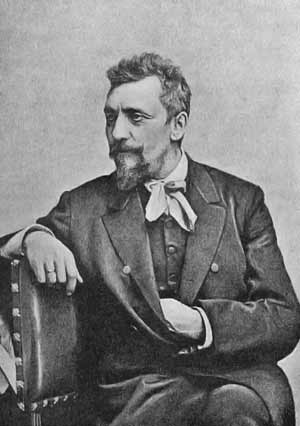
1834 - 1890
Copenhagen, Denmark
He was born in Copenhagen, Denmark and studied there at the Royal Danish Academy of Art (Det Kongelige Danske Kunstakademi) under Wilhelm Marstrand. Bloch's parents wanted their son to enter what they considered to be a respectable profession - an officer in the Navy. This, however, was not what he wanted. His only interest was drawing and painting, and he was consumed by the idea of becoming an artist. He went to Italy to study art, passing through the Netherlands,…