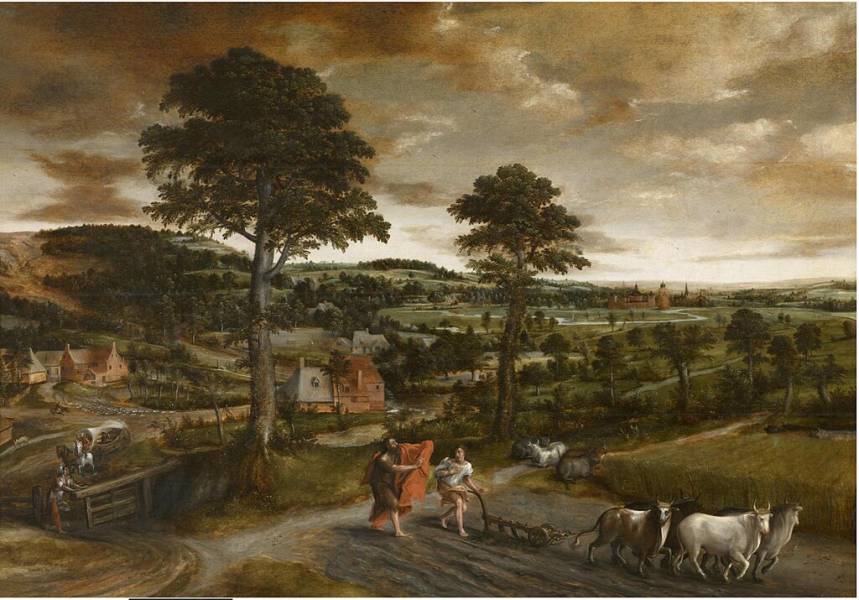
The Calling of Elisha
(c1572)
Jan Massijs
(Antwerp, 1510 - 1575)
1 Kings 19:19-21
1510 - 1575
Antwerp, Belgium
Jan Massijs (also spelled Matsys) was a Flemish Renaissance painter known for his history paintings, genre scenes, and landscapes. He is especially recognized for his sensual depictions of the female nude, influenced by the stylistic elegance of the School of Fontainebleau.
Born in Antwerp, Jan was the eldest son of the renowned painter Quinten Matsys and older brother of Cornelis Matsys, who also became a painter and engraver. He trained in his father’s workshop and, following Quinten’s death in 1530, Jan and Cornelis were admitted as masters to the Antwerp Guild of St. Luke in 1531. It is believed that Jan may have traveled shortly afterward, possibly working in Fontainebleau and Germany, although this remains uncertain. By 1536, he was back in Antwerp, and in 1538 he married his cousin, Anna van Tuylt, with whom he had three children.
In 1544, both Jan and his brother were banished from Antwerp for their religious beliefs. While his movements during exile are not fully documented, Jan is known to have spent time in Genoa, where he painted a rare portrait of Andrea Doria, one of his few known portraits. He returned to Antwerp by the end of 1555 after the ban was lifted and became involved in inheritance disputes with his siblings. Nevertheless, he regained enough standing to receive public commissions from the city council, though many of these works were lost during the Spanish Fury in 1576, when Spanish troops burned the Antwerp city hall. Jan died in Antwerp in 1575, reportedly in impoverished circumstances.
His son Quentin became a master in the Guild of St. Luke in 1574 and later died in Frankfurt in 1589. His daughter Susan emigrated to Italy, likely due to ongoing religious tensions.
Massijs trained several pupils, including Frans van Tuylt (1536), Frans de Witte (1543), and Olivier de Cuyper (1569).
His artistic career can be divided into three phases:
Early Period (before 1544) – Jan collaborated with his father and worked in his style, completing several unfinished pieces after Quinten’s death. His earliest known independent work, St. Jerome in His Cell (1537), strongly reflects his father’s influence.
Exile Period (1544–1555) – Only nine works from this time are known, some suggesting the stylistic influence of the School of Fontainebleau. It’s unclear whether he visited Fontainebleau or absorbed this style indirectly. This period also includes the portrait of Andrea Doria and two signed, dated works from 1552.
Later Period (post-1555) – After returning to Antwerp, Massijs reached his artistic peak. He developed a personal style distinguished by recurring themes of eroticism and the female nude, often using Old Testament subjects—Judith, Susanna, Bathsheba, the daughters of Lot—as vehicles for sensual imagery. These works recall the decorative elegance of Fontainebleau art. Prominent male biblical figures he painted include Tobias and Elias.
Jan Massijs is also credited as a pioneer of secular themes in Netherlandish painting. He explored subjects like “unequal love” (romantic pairings of vastly different ages), “merry companies”, money changers, tax collectors, and misers, often with a clear moralizing tone. While some of these themes may have originated with his father, Jan developed them further in a distinct and expressive style.
Although he painted some landscapes, this aspect of his work is less significant than that of his brother Cornelis, who was better known for the genre.
Jan Massijs remains a key figure in 16th-century Flemish art, notable for blending religious and moral content with a refined, sensual aesthetic that anticipated later developments in Northern European painting.
1 artwork found