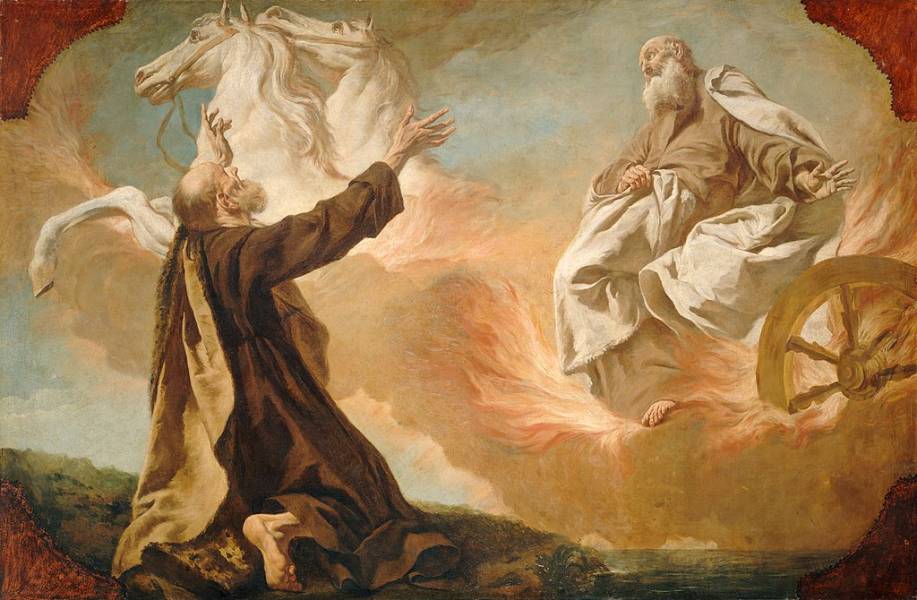
Giuseppe Angeli
(Venice, 1709 - 1798)
2 Kings 2:11-12
1709 - 1798
Venice, Italy
Giuseppe Angeli (1709–1798) was a Venetian painter of the late Baroque period, known for his work in both religious and genre scenes. Born in Venice in 1709, Angeli trained under the prominent painter Giambattista Piazzetta. By 1741, he had joined the local guild of painters. His connection to the Academy of Fine Arts of Venice began in 1756 when he was appointed as an instructor, eventually rising to the role of President in 1772.
Angeli’s works can be found throughout Venice and the surrounding region. Notable examples include two canvases in the Church of San Stae and fresco murals at Villa Widmann-Foscari in Mira, near Padua. Among his many religious commissions are:
He also completed decorative frescoes in the Villa Giovanelli Colonna at Noventa Padovana, a ceiling in the Scuola Grande di San Giovanni Evangelista, and works in the Palazzo Barbaro-Curtis in Venice. His genre painting Soldato con tamburo is housed in the Louvre.
Other notable works include a portrait of Federico Maria Giovannelli, Patriarch of Venice, held by the Museo Cerralbo in Madrid, and Elijah Taken Up in a Chariot of Fire, an oil painting created for San Giorgio in Alga (now part of the Samuel H. Kress Collection at the National Gallery of Art, Washington, D.C.).
1 artwork found