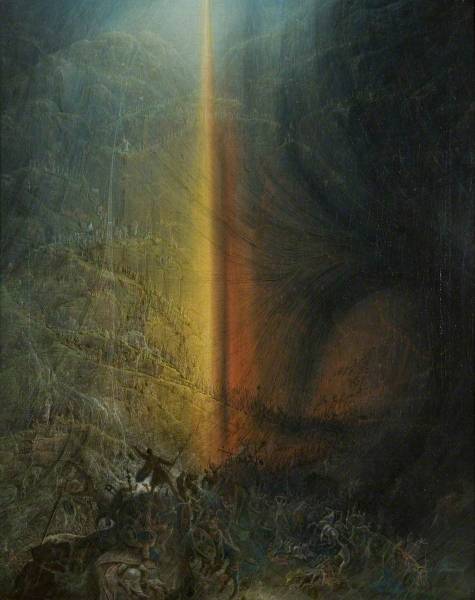
Born in Portland, Maine, Colman relocated to New York City alongside his family during his childhood. His father established a bookstore, attracting a clientele immersed in literature that might have impacted Colman's artistic journey. It's believed that he received brief tutelage from Asher Durand, a painter associated with the Hudson River School. Colman's first artwork was exhibited at the National Academy of Design in 1850. By 1854, he had established his own studio in New York City, and the subsequent year, he earned associate membership in the National Academy, eventually attaining full membership in 1862.
During the 1850s and 1860s, his landscape paintings were influenced by the Hudson River School's aesthetic, exemplified by pieces like "Meadows and Wildflowers at Conway" (1856), now held at the Frances Lehman Loeb Art Center at Vassar College. He also embraced the romantic style that gained popularity after the Civil War. One of his most recognized works, symbolizing the Hudson River School's essence, is "Storm King on the Hudson" (1866), a part of the Smithsonian American Art Museum's collection in Washington, DC.
Throughout the 1860s, Colman resided in Irvington, New York, producing paintings depicting the village's surrounding landscapes. Notably, Louis Comfort Tiffany, the innovator of Tiffany glass, studied under Colman during this period.
Colman's passion for travel is evident in many of his works, which portray scenes from various foreign cities and ports. He embarked on his first journey to France and Spain in 1860-1861, followed by an extended European tour in the early 1870s, spending ample time in Mediterranean locales. His artwork often featured architectural elements encountered during his travels—cityscapes, castles, bridges, arches, and aqueducts. In the 1870s and 1880s, he ventured to the western United States, crafting western landscapes akin to the style of Thomas Moran.
Following the Civil War, watercolor painting surged in popularity. In 1866, Colman co-founded the American Watercolor Society and served as its inaugural president from 1867 to 1871. He also excelled in etching and was an early member of the New York Etching Club. His etchings showcased European scenes and garnered popularity.
Colman's artistic pursuits expanded further in his later years. By the 1880s, he embraced interior design and collaborated with his friend Louis Comfort Tiffany on projects like Samuel Clemens' Hartford home and the Fifth Avenue residence of Henry and Louisine Havemeyer. He also delved into collecting Asian decorative items and authored books on geometry and art titled "Nature's Harmonic Unity" and "Proportional Form."
Colman's life journey concluded in 1920 in New York City. He found his resting place at Woodlawn Cemetery in the Bronx, New York.