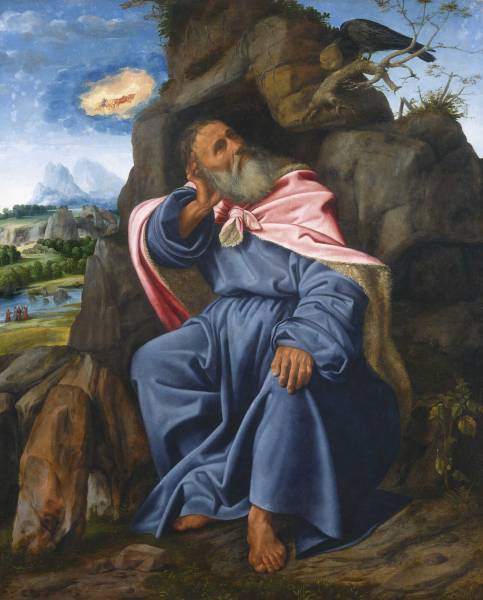
Elijah Fed by the Raven
(c1510)
Giovanni Girolamo Savoldo
(Brescia, 1480 - 1548)
1 Kings 17:1-6
1480 - 1548
Brescia, Italy
Giovanni Girolamo Savoldo, also known as Girolamo da Brescia, was an Italian High Renaissance painter who primarily worked in Venice and other cities in northern Italy. His artistic style was characterized by subtle use of color, skillful chiaroscuro, and a realistic approach, especially evident in his religious subjects and portraits. Though his oeuvre includes about 40 paintings, with only a few portraits and drawings known, he was highly regarded during his lifetime, with several commissioned works and copies of his art made by others.
Born in Brescia around 1480-1485, Savoldo's early life remains shrouded in mystery. He later became part of the Florentine painters' guild by 1508, and his works from that period, such as the Rest on the Flight into Egypt and the Elijah Fed by the Raven, display his artistic talent. His Portrait of a Clad Warrior and Temptation of Saint Anthony are notable creations from around 1515. The latter piece shows Saint Anthony praying while fleeing a nightmarish vision, influenced by Flemish artist Hieronymus Bosch. Savoldo's interest in Flemish painting continued as he moved to Venice before 1521, where he gained appreciation for his artworks.
In 1524, he signed a contract for an altarpiece for the church of San Domenico in Pesaro, and later completed a Saint Jerome painting for the Brescian family Averoldi in 1527. His Nativity at the National Gallery of Art in Washington, painted in the 1530s, shows influence from Correggio's work on the same subject. Among other notable pieces, Savoldo executed the altarpiece for the main altar of Santa Croce, Brescia, in 1537–1538. The 1540s saw him paint Nativity scenes for the churches of San Giobbe in Venice and San Barnaba in Brescia, along with the well-known Magdalene painting.
Savoldo's influence extended to his students, including Paolo Pino. He possibly spent some time in Milan, and his art was favored by Francesco II Sforza, Duke of Milan. Little is known about Savoldo's personal life, except that he had a Dutch wife. The exact date of his death remains uncertain, with records mentioning him as still living in Venice in 1548, though very old. Despite being forgotten for three centuries after his death, a rediscovery of his art began in the mid-19th century, establishing him as a significant figure among the major High Renaissance masters. His art continues to be appreciated and admired for its technical skill and evocative portrayal of religious and mythological subjects.
1 artwork found