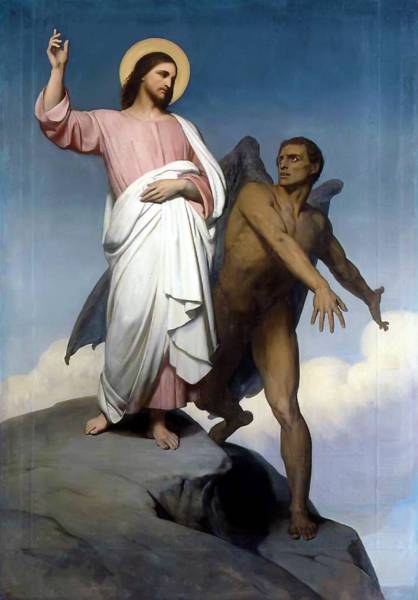
The Temptation of Christ
(1854)
Ary Scheffer
(Dordrecht, 1795 - 1858)
Matthew 4:1-11
1795 - 1858
Dordrecht, Netherlands
Ary Scheffer was a Dutch-French Romantic painter born on February 10, 1795, to a family of artists. His father, Johan Bernard Scheffer, was a portrait painter, and his mother, Cornelia Lamme, was a portrait miniature painter. Scheffer's artistic talent was nurtured from a young age, and he attended the drawing academy in Amsterdam at the age of 11. After his father's death in 1809, Scheffer moved to Lille and later to Paris, where he studied at the École des Beaux-Arts under Pierre-Narcisse Guérin.
Scheffer's artistic style was characterized by his use of dramatic lighting, intense emotions, and a focus on literary and religious subjects. He was particularly drawn to the works of Dante, Goethe, and Lord Byron, and his paintings often depicted scenes from their writings. Scheffer's religious paintings, including his depictions of biblical scenes, showcased his ability to convey complex emotions and ideas through his art. Some of his notable works include paintings based on the lives of Christ and the Virgin Mary, which demonstrated his mastery of composition and his ability to evoke a sense of spirituality.
Throughout his career, Scheffer was recognized for his artistic talent and was awarded numerous commissions and honors. He became a prominent portrait painter, capturing the likenesses of famous and influential people of his time, including the Marquis de Lafayette. Scheffer's connection to the royal family, particularly King Louis Philippe I, brought him wealth and prestige, and he was elevated to the rank of commander of the Legion of Honour in 1848. Despite the turmoil of the French Revolution of 1848, Scheffer continued to produce notable works, including paintings and portraits that reflected his artistic range and depth.
Scheffer's legacy as a Romantic painter has endured long after his death on June 15, 1858. His paintings continue to be celebrated for their emotional intensity, technical skill, and attention to detail. As a prominent artist of his time, Scheffer played a significant role in shaping the artistic landscape of 19th-century Europe, and his works remain a testament to his innovative and expressive style. His daughter, Cornélia, also became an artist, following in her father's footsteps and ensuring that the Scheffer name remained associated with artistic excellence for generations to come.
1 artwork found