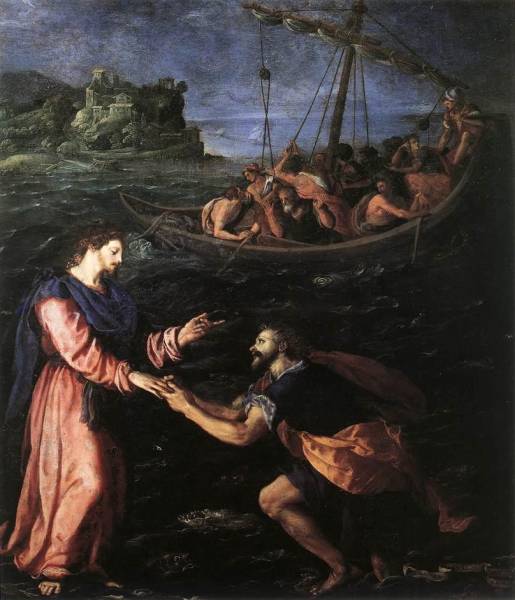
St Peter Walking on the Water
(c1590)
Alessandro Allori
(Florence, 1535 - 1607)
Matthew 14:25-31
1535 - 1607
Florence, Italy
Alessandro Allori (1535-1607) was one of the most prominent painters of the late Mannerist Florentine school, representing the final flowering of a distinguished artistic lineage. After his father's death in 1541, Allori was raised and trained by the renowned Agnolo Bronzino, creating such a close bond that both Alessandro and his son would sometimes use the Bronzino name. His artistic education was further enriched by a formative trip to Rome (1554-1560) and rigorous anatomical studies, including the dissection of human corpses provided by the Hospital of Santa Maria Nuova.
Allori's mastery of the Mannerist style is evident in his biblical and religious works, which demonstrate his characteristic blend of technical precision and emotional restraint. His "Christ and the Samaritan Woman," originally created as an altarpiece for Santa Maria Novella in 1575, exemplifies his ability to render sacred narratives with crystalline clarity and sophisticated compositional arrangement. Other notable religious works include "Dead Christ and Angels" and "Susanna and the Elders," where his figures possess an almost sculptural quality, their polished surfaces and idealized forms reflecting the Mannerist aesthetic he had inherited from Bronzino.
During his career's peak, Allori headed one of Florence's two most important workshops in the second half of the 16th century and held prestigious positions including First Consul of the Accademia del Disegno (1573) and head of the Medici state tapestry workshop (1581). His versatility extended beyond religious subjects to include portraits and allegorical scenes, notably his contributions to the Studiolo of Francesco I in the Palazzo Vecchio. While some critics like S.J. Freedberg viewed him as overly derivative, art historian Simona Lecchini Giovannoni praised his ability to breathe life into "grandiose, introverted figures" through meticulous attention to realistic details—flowers, textiles, and household objects that create tangible connections with viewers.
As the father of painter Cristofano Allori and teacher to numerous pupils including Giovanni Bizzelli, Alessandro Allori represents both the culmination and conclusion of the great Florentine painting tradition that traced back through Bronzino and Pontormo to Andrea del Sarto. His legacy marks the end of an era of undiluted Tuscan artistic heritage, as subsequent generations would embrace the Baroque styles emerging from other parts of Italy.
1 artwork found